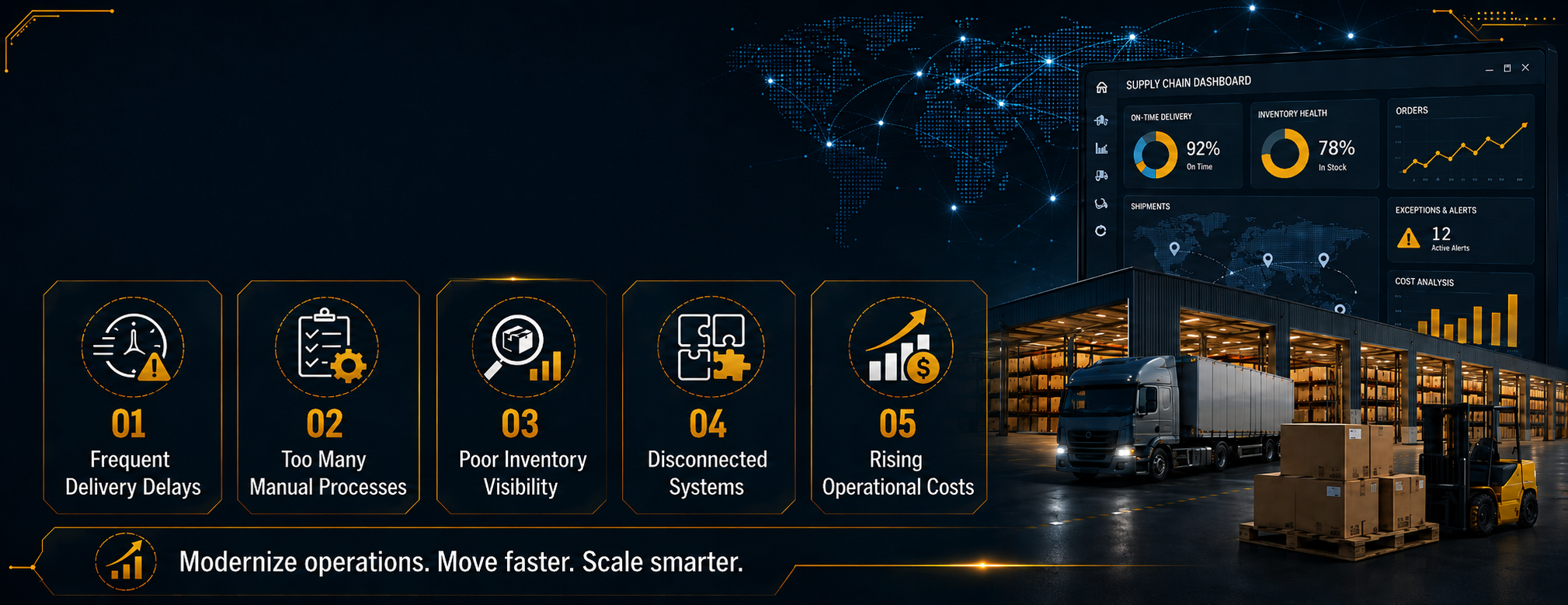
Every growing business depends on a smooth flow of raw materials, inventory, vendors, warehouses and delivery schedules. But many manufacturers, distributors and retailers still manage their supply chain through Excel sheets, WhatsApp updates, phone calls or manual registers.
This creates stock mismatches, delayed orders, poor vendor visibility and disconnected teams. A custom Supply Chain Management (SCM) system solves these problems by connecting procurement, inventory, vendors and order fulfillment in one smart, real-time platform.
At ASharp Infotech, we build custom supply chain management software for businesses that want better inventory visibility, faster procurement, reliable vendor tracking and complete supply chain control.
What Is a Custom Supply Chain Management System?
A supply chain management software is a system that helps businesses manage procurement, inventory, vendors, warehousing, order processing and delivery tracking from one centralized dashboard.
Unlike off-the-shelf SCM tools, a custom SCM system is built according to your actual operations. Whether you manage manufacturing units, multiple warehouses, distributor networks or retail inventory, the system can be designed around your exact workflow.
Real-Time Inventory Tracking
Track stock levels across multiple warehouses and locations with live, accurate data.
Procurement Management
Manage purchase orders, vendor quotes, approvals and delivery timelines in one place.
Vendor Performance Tracking
Store vendor delivery history, pricing trends, order accuracy and reliability records.
Benefits of Custom SCM Software for Your Business
-
•
Centralized Inventory Visibility: A custom SCM system shows real-time stock levels across every warehouse, eliminating mismatched numbers and last-minute surprises.
-
•
Faster Procurement Cycles: Purchase orders, approvals and vendor communication move faster when everything is tracked digitally instead of over calls and emails.
-
•
Better Vendor Accountability: SCM software tracks delivery timelines, order accuracy and pricing history, helping you identify your most reliable vendors.
-
•
Reduced Stock Errors: Automated tracking removes the manual counting and spreadsheet errors that lead to overstocking or stockouts.
-
•
Cross-Team Coordination: Purchasing, warehousing, sales and finance all work from the same real-time data, removing confusion between departments.
-
•
Instant Reporting: Generate inventory, procurement and vendor reports in seconds instead of compiling data manually for hours.
Why Businesses Should Avoid Manual Supply Chain Tracking
Manual tracking may work when order volume is low. But as a business grows across multiple warehouses, vendors and sales channels, managing everything through spreadsheets becomes risky and time-consuming.
Without a proper supply chain management system, businesses often face stock mismatches, delayed deliveries, duplicate purchase orders and poor coordination between teams.
| Area | Manual Tracking | Custom SCM Software |
|---|---|---|
| Inventory Data | Spreadsheets and manual stock counts | Real-time stock levels across all locations |
| Procurement | Calls, emails and manual approvals | Digital purchase orders with tracked approvals |
| Vendor Tracking | Difficult to track performance over time | Delivery history, pricing and reliability logged automatically |
| Reporting | Hours of manual data compilation | Instant dashboards with live reports |
| Team Coordination | Disconnected data across departments | Single source of truth for every team |
| Scalability | Harder to manage as business grows | Built to scale with more products and locations |
Key Features of a Supply Chain Management System
Multi-Warehouse Management
Track inventory separately across multiple warehouses or locations from a single dashboard.
Purchase Order Automation
Create, approve and track purchase orders digitally with full order history.
Order & Delivery Tracking
Monitor order status from procurement to delivery with real-time updates.
Vendor Performance Reports
Compare vendors by delivery time, pricing and order accuracy to make better decisions.
Low-Stock Alerts
Automatic alerts when inventory drops below a set threshold, preventing stockouts.
Role-Based Access
Give teams access only to the data relevant to their role — procurement, warehouse or finance.
How SCM Software Connects With Your ERP and Sales Systems
A supply chain system becomes even more powerful when connected with your ERP and sales data. When inventory, procurement and order information flow into the same system as production and finance, your entire operation runs on one consistent set of numbers.
With the right ERP and CRM development services, your business can connect supply chain data directly with production planning, finance and customer orders — giving every team a complete, real-time picture.
ERP Integration
Sync inventory and procurement data directly with production planning and finance.
Sales Order Sync
Connect customer orders with live inventory to avoid overselling or fulfillment delays.
Demand Forecasting
Use historical order data to plan procurement and avoid overstocking or shortages.
Custom SCM vs Ready-Made Supply Chain Software
| Factor | Ready-Made SCM | Custom SCM |
|---|---|---|
| Workflow | Fixed standard process | Built around your actual procurement and inventory process |
| Warehouses | Limited multi-location support | Designed for your exact number of warehouses and locations |
| Reports | Generic reports | Reports based on your vendors, products and teams |
| Integrations | May need third-party tools | Can be connected directly with ERP, CRM and sales systems |
| Scalability | Depends on available plans | Can grow with your business needs |
Which Businesses Need Custom Supply Chain Software?
Manufacturers
Manage raw material procurement, production inventory and supplier coordination in one system.
Wholesalers & Distributors
Track bulk inventory, vendor orders and multi-location stock movement with accuracy.
Retail Chains
Sync inventory across multiple stores and avoid overstocking or stockouts at any location.
Logistics & Warehousing Companies
Manage warehouse operations, order fulfillment and delivery tracking at scale.
Need a Custom Supply Chain Management System for Your Business?
ASharp Infotech can build a custom SCM system to manage inventory, procurement, vendors, order tracking and supply chain reporting.
Get Free ConsultationConclusion
A custom Supply Chain Management system helps businesses manage inventory, procurement, vendors and order fulfillment more efficiently. It reduces manual errors, speeds up reporting and gives complete control over the entire supply chain process.
For businesses managing multiple warehouses, vendors and sales channels, a supply chain management system can become a powerful tool for accuracy, efficiency and growth.
To build an SCM system designed around your business workflow, contact ASharp Infotech and discuss your project requirements with our team.
Share this article: