A busy telesales team can speak to hundreds of prospects in a day, yet sales still slow down when follow-ups are missed, remarks are unclear or confirmed orders remain stuck between sales, accounts, dealers and dispatch. The real problem is rarely a lack of effort. It is the absence of one connected process.
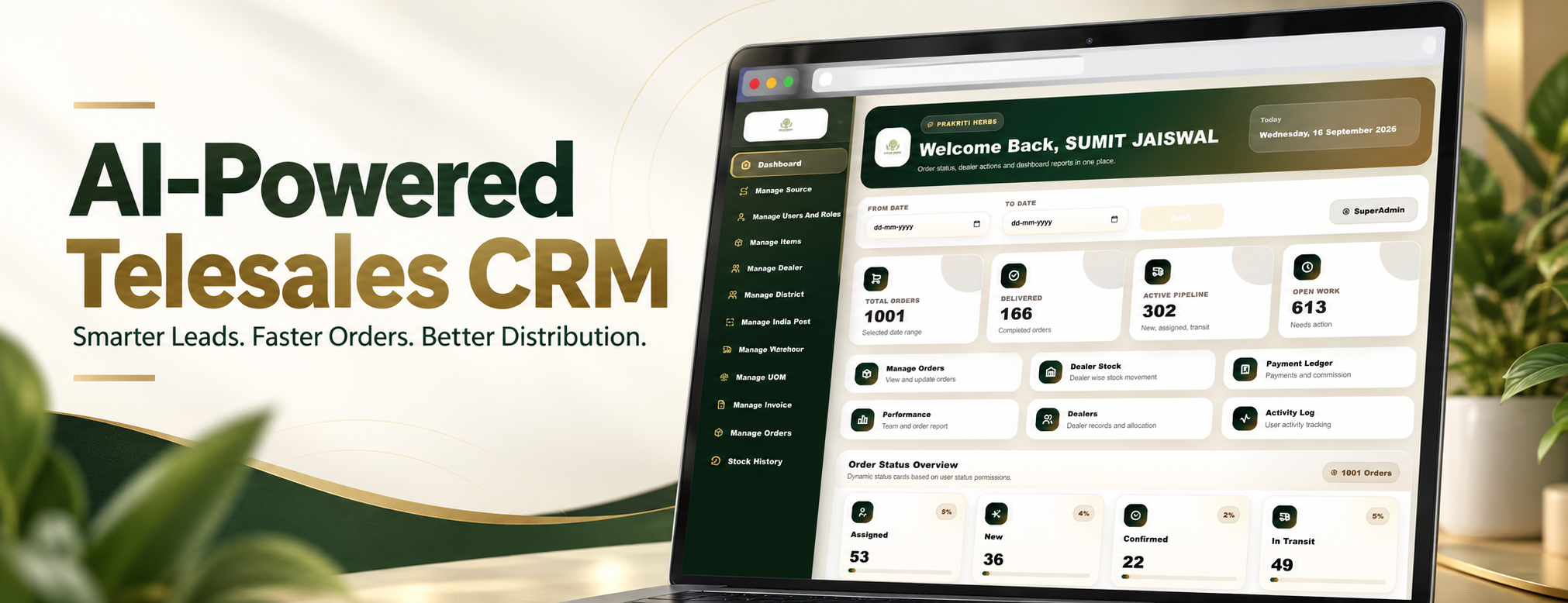
An AI-powered telesales CRM brings calls, lead history, follow-ups, orders, dealer allocation and management reporting into the same workflow. Instead of asking employees to remember every detail or update multiple spreadsheets, the system keeps the next action visible and gives managers a clearer picture of what is actually happening.
That is the thinking behind the ASharp Telesales and Distribution CRM: practical automation for businesses that receive leads, convert them through telecalling and then fulfil orders through an internal team, courier partner or dealer network.
Why Telesales Teams Lose Good Opportunities
Most telesales teams do not lose leads because employees never called them. Opportunities are usually lost in the gaps between one call and the next. A prospect asks to be contacted on Friday, but the reminder remains in a notebook. Another customer confirms an order, but the address is incomplete. A manager sees the total call count but cannot tell whether those calls moved prospects closer to a purchase.
These small gaps become expensive when lead volume increases. Agents start working from memory, the same prospect may receive duplicate calls, and managers spend time collecting updates instead of coaching the team. A CRM should remove this uncertainty by giving every lead a clear owner, current status, next follow-up and complete activity history.
What Makes an AI-Powered Telesales CRM Different?
A conventional CRM stores information. An AI-powered CRM can also help users understand that information and decide what deserves attention. AI does not replace the telesales agent. It supports the agent by reducing repetitive work and turning unstructured call notes into useful actions.
Lead Prioritisation
Highlight leads that show stronger buying intent, recent engagement or an urgent follow-up requirement.
Remark Summaries
Convert long call remarks into a short summary with the customer’s concern, interest and agreed next step.
Smarter Follow-Ups
Keep callbacks visible and help agents focus on leads that are due, overdue or likely to go cold.
The best use of AI is not a flashy chatbot added to the dashboard. It is a set of small, useful improvements that help the team work faster while keeping people responsible for the final decision.
How the CRM Improves the Complete Sales and Order Process
-
01
Lead Capture: Leads from websites, advertisements, uploaded files or connected sales channels enter one central queue with their original source recorded.
-
02
Assignment: Leads are assigned to the right telesales agent so ownership is clear and duplicate calling is reduced.
-
03
Conversation: The agent records the outcome, customer concern, product interest, order potential and next follow-up date after each interaction.
-
04
Conversion: Once the customer is ready, the confirmed lead becomes an order without the team entering the same information again.
-
05
Fulfilment: The order moves to the relevant dealer, warehouse or courier workflow with its current status visible to authorised users.
-
06
Review: Managers can compare leads, follow-ups, confirmed orders, cancellations, deliveries and collections without preparing a separate report manually.
A Clearer Day for Every Telesales Agent
Agents should not begin the day by searching several sheets to decide whom to call. Their dashboard should show new leads, scheduled callbacks, overdue follow-ups and recently assigned enquiries in a sensible order.
Before making a call, the agent can see the customer’s earlier conversations, product interest, previous objections and latest order position. After the call, a structured status and follow-up date keep the process moving. AI-assisted summaries can make long remark histories easier to understand, especially when a lead moves to another employee.
This does not force agents to follow a robotic script. It gives them the context needed to have a more relevant conversation.
From Confirmed Lead to Managed Order
A common weakness in sales software is that its usefulness ends when the lead converts. The salesperson marks the enquiry as won, and the rest of the order is managed somewhere else. That break creates repeated data entry and makes it harder for sales staff to answer a customer asking for an update.
ASharp Telesales and Distribution CRM connects the sales conversation with order processing. Customer details, address, products, quantity, payment information and remarks can move into the order workflow. The team can then track confirmation, dealer assignment, dispatch, delivery, cancellation or return from the same connected record.
This is especially useful for D2C brands, Ayurvedic and wellness companies, telemarketing businesses and organisations that process a high volume of cash-on-delivery orders.
Better Distribution Through Dealer and Territory Management
For a business with regional dealers, generating an order is only half the job. The order must reach a dealer who covers the customer’s area and can fulfil it. A distribution CRM can map dealers to states, districts or pincodes and keep the assignment visible throughout the order journey.
Where business rules allow it, the platform can help distribute orders according to territory, availability or a predefined allocation ratio. Managers still retain control to review and change an assignment when a real-world exception occurs.
Territory Mapping
Connect dealers with the states, districts and pincodes they actually serve.
Stock Visibility
Track products moving between the warehouse and dealers instead of relying on separate stock sheets.
Dealer Ledgers
Keep invoices, receipts, returns and outstanding balances connected to each dealer account.
Managers Get More Than a Call Count
A high number of calls does not automatically mean the sales process is healthy. Managers need to understand what happened after those calls. How many new leads were contacted? How many callbacks are overdue? Which objections appear repeatedly? Which agent converts confirmed orders into successful deliveries? Which lead source produces volume but poor-quality enquiries?
A connected dashboard can bring these answers together. Useful reports may include agent-wise lead activity, status movement, callback completion, order conversion, cancellation reasons, delivery performance, source-wise results and dealer-wise fulfilment.
AI can support this review by summarising patterns in remarks and highlighting unusual changes. The numbers remain available for verification, while the summary helps managers reach the important part faster.
What Changes After Implementation?
| Before the CRM | After the CRM |
|---|---|
| Follow-ups depend on diaries, personal reminders or spreadsheets. | Due and overdue follow-ups remain visible in each agent’s work queue. |
| Managers ask agents individually for sales updates. | Lead movement, orders and team performance appear on live dashboards. |
| Confirmed orders are entered again in another system. | The lead and its customer details continue into the order workflow. |
| Dealer assignment happens through calls and messages. | Territory rules and recorded assignments create a clearer distribution process. |
| Long remarks are difficult to review quickly. | AI-assisted summaries highlight customer intent, concerns and next steps. |
AI Must Support the Team, Not Control It
AI recommendations should be treated as assistance, not unquestionable instructions. An agent may know that a valuable customer asked not to be called before a particular date. A manager may need to change a dealer assignment because of a local stock issue. The CRM should preserve this human judgement and record why an override was made.
Data quality also matters. If users select incorrect statuses or write vague remarks, no AI model can create a completely reliable picture. Clear processes, sensible permissions and regular review remain the foundation of useful automation.
Ready to Connect Telesales, Orders and Distribution?
ASharp Infotech builds custom CRM software around the way your sales and fulfilment teams actually work.
Discuss Your CRMFinal Thought
An AI-powered telesales CRM is valuable because it connects the small decisions that determine whether a lead becomes a successful order. It helps the agent remember the next conversation, gives the order team complete information, keeps dealer allocation visible and lets management review performance without chasing updates.
The goal is not to replace people with software. It is to give people a clearer process, better context and fewer repetitive tasks so they can spend more time speaking with customers and solving the issues that actually require human attention.
Share this article: