Growing businesses usually have plenty of data. The problem is that this data often sits in different places—sales reports, inventory sheets, purchase records, production registers and accounting software. An ERP brings these records together, while AI in ERP helps teams make better use of the information already available.
Imagine knowing that a product may run out before the shortage affects an order, or receiving an alert when an expense looks unusual compared with previous transactions. These are the practical advantages of AI-powered ERP software. It helps people notice what deserves attention without asking them to review every report manually.
This does not mean placing a chatbot on every ERP screen. In most businesses, the best use of Artificial Intelligence in ERP is much simpler: forecasting demand, identifying unusual activity, suggesting reorder quantities or preparing a short summary for management.
ASharp Infotech develops custom ERP systems around the way a business actually works. This allows companies to introduce AI and ERP automation where they can solve a real operational problem—not simply because AI happens to be popular.
What Changes When AI Is Added to ERP?
A traditional ERP is excellent at recording what has already happened. It can show what the company purchased, sold, produced, dispatched or paid. However, employees still need to study those records and decide what to do next.
An intelligent ERP system can help with this next step. It can examine historical information, identify patterns and bring unusual activity to the user’s attention. For example, it may predict that a product is likely to run low, highlight a payment that looks different from normal transactions or point out a supplier whose deliveries are repeatedly late.
The final decision should still remain with the responsible employee. AI is most useful when it helps that person reach a well-informed decision faster and provides enough context to understand why a recommendation was made.
Practical Uses of AI Inside an ERP
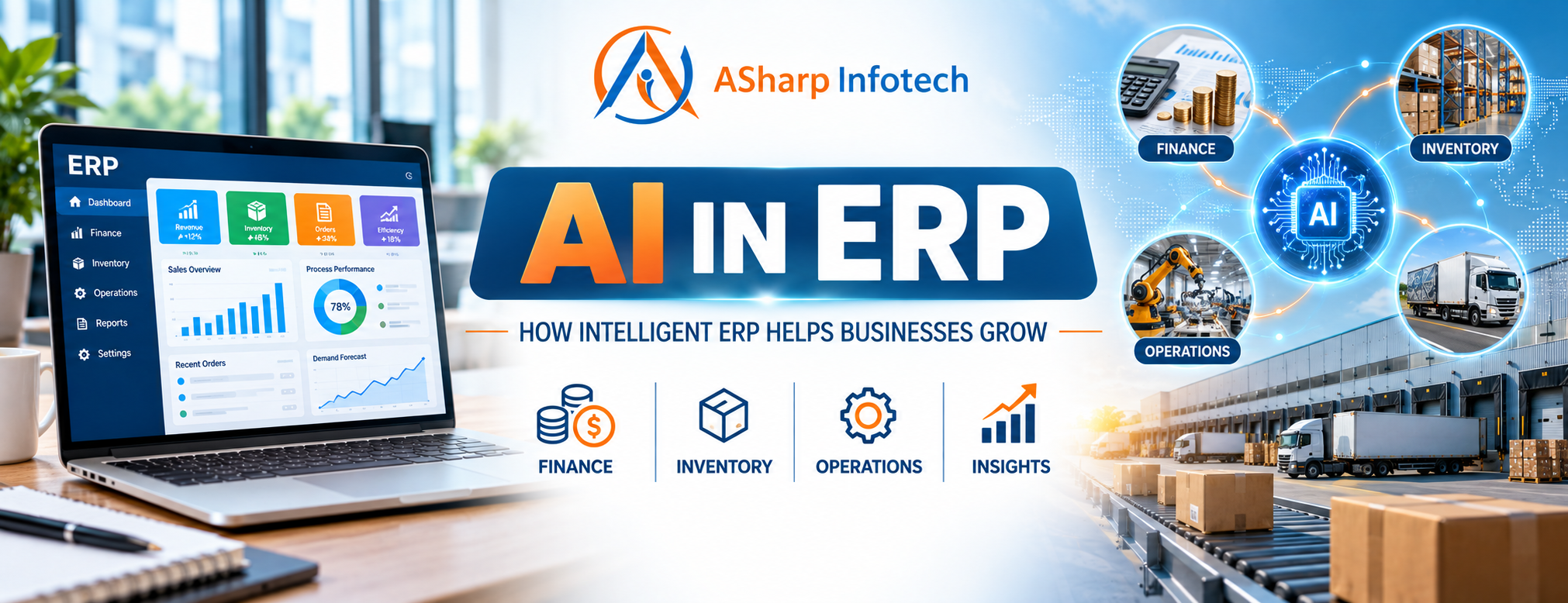
Smarter Inventory Planning
Estimate future demand, identify slow-moving items and suggest reorder levels using sales patterns and supplier lead times.
Early Exception Detection
Bring unusual expenses, possible duplicate entries, unexpected price changes and delayed approvals to the user’s attention.
Clearer Management Insights
Convert large volumes of operational data into useful summaries that explain what changed and where attention may be needed.
The right use case will depend on the nature of the business. A manufacturer may use predictive analytics in ERP to estimate material requirements or spot a production stage that regularly causes delays.
A distributor may compare supplier lead times, order fulfilment rates and product movement before making a purchase decision. A retailer may use store-level buying patterns to improve AI inventory management across different locations.
Finance teams can also benefit. Instead of waiting until the end of the month to discover an unusual expense, the system can highlight a transaction that does not match established behaviour and send it for review.
How AI Can Improve Everyday ERP Decisions
The value of AI-powered ERP software is not limited to faster reports. Its real value appears when it helps employees handle everyday decisions with greater clarity.
- Faster decisions: Managers can begin with the information that needs attention instead of reading several reports from beginning to end.
- Better demand planning: Past sales, seasonal changes and current orders can provide a more realistic estimate of future requirements.
- Stronger inventory control: The system can highlight products that are moving slowly, running low or behaving differently from their usual sales pattern.
- Less manual analysis: ERP data analytics can organise operational records into summaries that are easier for managers to understand and act upon.
- Earlier warnings: Unusual transactions, sudden price changes and delayed approvals can be flagged before they turn into larger problems.
- Better process visibility: Teams can see where work is slowing down and which department or approval stage requires attention.
AI Makes ERP Automation More Flexible
Traditional ERP automation works through fixed rules. For example, the system may send an alert when stock falls below a predefined quantity or when an invoice remains pending for more than five days.
These rules are useful, but they do not always reflect changing business conditions. A fixed reorder level may work during an average month but fail during a seasonal increase in demand.
AI can make the recommendation more relevant by considering previous sales, current orders, seasonal patterns and supplier lead times. Instead of simply warning that stock is low, the ERP may suggest how much stock is likely to be required and explain which factors influenced the recommendation.
This combination of clear business rules and AI-supported recommendations can make business process automation more useful without taking important decisions away from employees.
AI Is Only as Reliable as Your ERP Data
AI cannot fix every problem created by incomplete or inconsistent records. If purchase entries are missing, sales are recorded several weeks late or stock movements never reach the ERP, the resulting forecast will be based on an inaccurate version of the business.
Even small inconsistencies can matter. If two warehouses use different names for the same product, the system may treat them as separate items. If employees use several codes for one supplier, the ERP may not produce an accurate supplier-performance report.
Before introducing AI in ERP, businesses should clean their master data, define who is responsible for each type of record and ensure that important workflows are being followed consistently.
Better ERP data analytics begins with disciplined data entry. AI can find patterns within the information it receives, but it cannot reliably analyse a transaction that was never recorded.
A Practical Roadmap for Implementing AI in ERP
| Stage | Business Focus | Expected Outcome |
|---|---|---|
| 1. Data Readiness | Clean master data and standardise important ERP processes | A dependable foundation for AI |
| 2. Select One Use Case | Choose a recurring problem with a measurable business impact | A focused and manageable pilot |
| 3. Human Review | Allow authorised users to review, approve or reject recommendations | Safer adoption and better feedback |
| 4. Measure the Result | Track accuracy, time saved and financial impact | Clear evidence of business value |
| 5. Expand Gradually | Introduce additional use cases after the pilot is proven | Sustainable operational improvement |
Businesses do not need to make the entire ERP intelligent on the first day. A smaller pilot is usually more useful because it gives the team an opportunity to understand the recommendation, measure its accuracy and improve the underlying process.
A company may begin with slow-moving stock identification, purchase forecasting or unusual-expense alerts. Once the result is reliable and employees are comfortable using it, the same approach can be expanded into other departments.
Why Custom ERP Development Matters
Two businesses in the same industry may still follow very different approval, purchasing, production and inventory processes. A standard ERP can provide common modules, but it may not capture the information needed to support a company-specific decision.
With custom ERP development, workflows, permissions, reports and data structures can be designed around the operation itself. This creates a stronger foundation for introducing relevant AI features.
A manufacturer may need production-delay analysis and material forecasting. A distributor may be more interested in supplier performance and dealer stock. A manpower company may require attendance analysis, salary calculations and client-invoice forecasting.
The best AI feature is therefore not the one with the most impressive name. It is the one that helps the business make an important, repeated decision more accurately or in less time.
Keep People in Control
ERP decisions can affect purchasing, payments, salaries, production schedules and stock availability. Recommendations in these areas should be explainable, permission-controlled and reviewed by the right employee.
The business should clearly define what the intelligent ERP system is allowed to suggest and which actions still require human approval. Audit logs should record who accepted, rejected or changed a recommendation.
Sensitive business information must also be protected. Users should only have access to the records required for their role, and important financial or operational actions should continue to follow the company’s approval process.
AI should make employees better informed, not remove accountability from the process.
Ready to Make Your ERP More Intelligent?
ASharp Infotech builds custom ERP systems, practical automation and AI-supported features around the way your business actually operates.
Discuss Your ERPFinal Thought
AI in ERP does not replace the original purpose of an ERP system. It builds on the information and processes already available. When the underlying data is accurate, AI can help teams identify patterns earlier, improve forecasts and spend less time searching through reports.
Instead of beginning with the question, “Where can we add AI?”, start with a more practical one: “Which repeated decision is costing the business the most time, money or effort?”
The answer will reveal the best starting point for an AI-powered ERP system that delivers genuine business value instead of becoming another feature that nobody uses.
Share this article: