If your business deals with inventory, purchasing, warehousing, or logistics, you have probably heard ERP and supply chain management mentioned in the same conversation. One person says the company needs an ERP; another believes the real issue lies in the supply chain. In many cases, both are right—they are simply looking at the problem from different angles.
Understanding the difference is important before you invest. It helps you identify the type of software your business truly needs, assess development costs more realistically, and avoid building a system that solves the wrong problem.
Based in Netaji Subhash Place, Delhi, ASharp Infotech develops custom ERP and supply chain solutions for growing businesses across India. We also provide website development, mobile app development, and digital marketing services, giving our clients one technology partner who understands how the different parts of their business connect.
What Does an ERP System Cover?
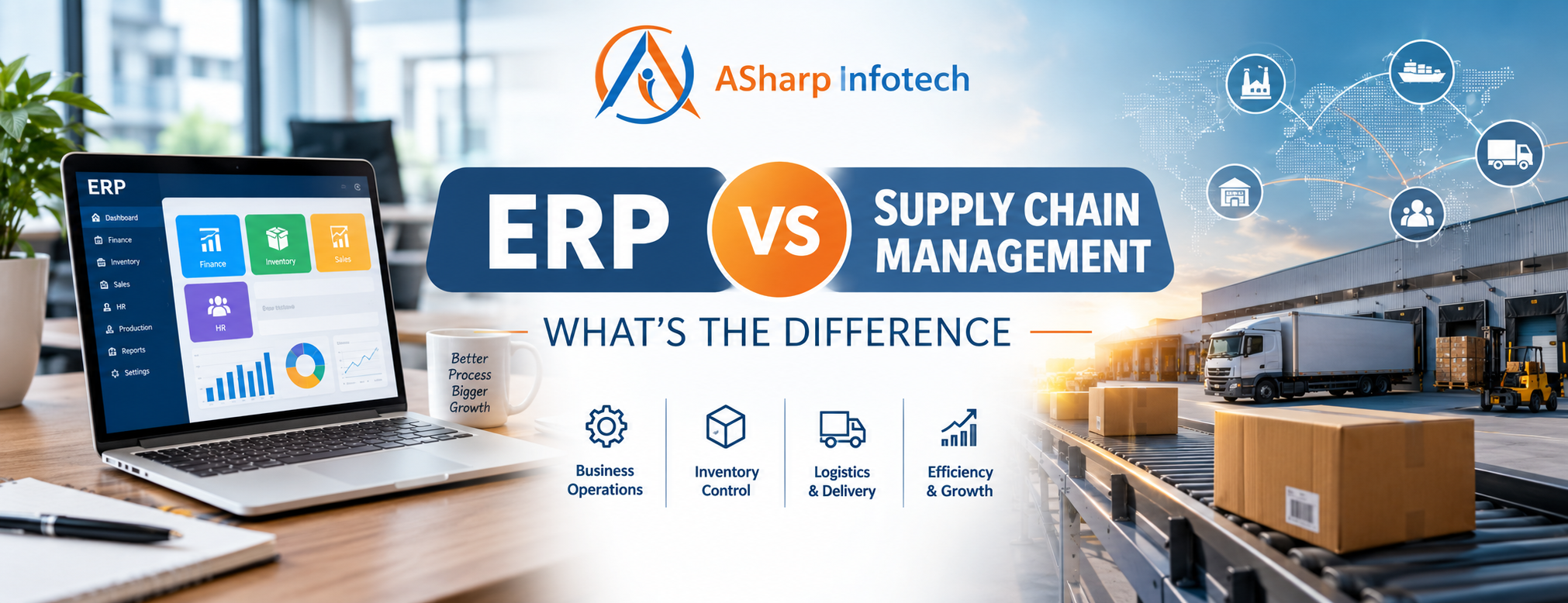
Enterprise Resource Planning, better known as ERP, brings a company’s internal functions together on one platform. Depending on the business, it may include finance, human resources, inventory, procurement, sales, and production.
Without an ERP, departments often maintain separate spreadsheets or use tools that do not communicate with one another. That is when different teams start working with different numbers. An ERP creates a shared source of information, making it easier to take faster decisions and reduce avoidable mistakes.
A good ERP does more than store records. It connects everyday activities across departments. For example, when a sale is entered, stock can be updated automatically. If inventory falls below a set level, the purchase team can receive an alert. Once a purchase order is raised, the finance team can immediately see the expected cost.
This is where an experienced custom software development company India businesses can rely on adds real value. The system should fit the way your company operates instead of forcing your team to work around a rigid, generic process.
What Does Supply Chain Management Cover?
Supply chain management, or SCM, focuses on how goods move—from sourcing raw materials to delivering the finished product to the customer. It covers areas such as supplier management, purchasing, transportation, warehousing, demand forecasting, and coordination with distributors.
An ERP mainly connects what happens inside the organisation. Supply chain management follows the product’s wider journey, which often involves several outside parties, including suppliers, transport partners, warehouses, and distributors.
For this reason, a custom supply chain software development company usually concentrates on improving visibility and coordination across the entire network, not only between internal departments.
Where Do ERP and Supply Chain Management Overlap?
In day-to-day business, ERP and supply chain management rarely operate in complete isolation. Many modern ERP platforms include supply chain modules, while dedicated SCM systems still need information from finance, sales, purchasing, and inventory.
This is why ERP for supply chain management integration is so valuable. When both systems communicate properly, information moves automatically and teams do not have to enter the same data again in different places.
Unified Data Flow
Sales, inventory, and purchasing information moves between ERP and supply chain systems without repeated manual entry.
Real-Time Visibility
Teams can see current stock levels, shipment progress, and supplier performance using the same up-to-date information.
Fewer Costly Errors
Automated data sharing reduces the chance of finance, operations, and logistics working with mismatched figures.
ERP vs Supply Chain Management: A Side-by-Side Comparison
| Area of Concern | ERP | Supply Chain Management |
|---|---|---|
| Primary Focus | Internal business operations | Movement of goods from supplier to customer |
| Core Departments | Finance, HR, inventory, and sales | Procurement, logistics, and warehousing |
| Data Direction | Connects data within the organisation | Connects data across external partners |
| Common Users | Finance, operations, and management teams | Procurement, logistics, and warehouse teams |
| Best For | Businesses that need stronger internal coordination | Businesses managing complex sourcing and delivery |
| Ideal Combined Use | Integrated for end-to-end visibility | Integrated for end-to-end visibility |
This comparison shows why “Which one should we choose?†is not always the most useful question. For many businesses, the better question is how ERP and SCM can be connected to create one reliable flow of information.
Signs Your Supply Chain Needs a Digital Overhaul
Many businesses continue managing their supply chain through spreadsheets, calls, and WhatsApp messages even after the process has become too complex. It may appear manageable on normal days, but problems become obvious when orders increase or something goes wrong.
Common signs your supply chain needs digital overhaul include frequent stock-outs despite the system showing available inventory, overstocking slow-moving products, delayed shipments noticed only after a customer follows up, and supplier or warehouse figures that do not match finance records.
If your staff also spends hours checking and reconciling data manually, the problem is not necessarily your team. More often, people simply do not have a clear, shared view of what is happening. A well-designed digital system gives them that visibility.
Benefits of Custom ERP for a Growing Business
Ready-made ERP software can be a practical starting point, especially for a small company. Problems arise when its fixed workflows no longer match the way the business operates.
One of the main benefits of custom ERP for growing business operations is flexibility. Instead of asking employees to change a proven process simply because the software demands it, the system can be designed around the company’s actual workflow.
A custom ERP can also grow in stages. New product lines, locations, warehouses, users, and approval processes can be added as the business expands. This reduces the risk of replacing the entire platform a few years later because the original software can no longer keep up.
ERP Software for Retail Business in India: A Practical Example
Retail clearly shows why ERP and supply chain functions need to work together. ERP software for retail business India companies use may need to manage inventory across several stores or warehouses, create supplier orders, handle billing and GST requirements, and track seasonal demand.
All of this information must stay connected with what is happening at the billing counter, on the shelf, in the warehouse, and with the supplier. If even one part remains disconnected, stock figures and purchasing decisions can quickly become unreliable.
Affordable ERP Software Development in India: How to Start Sensibly
Small and mid-sized businesses often assume that custom ERP software is only affordable for large enterprises. That does not have to be the case. The cost depends heavily on how the project is planned and which features are included in the first phase.
Affordable ERP software development India businesses can adopt usually begins with the modules creating the biggest operational impact—often inventory, procurement, finance, or sales. Additional features can then be introduced in phases once the first modules are stable and delivering measurable value.
This approach keeps the initial investment under control and gives employees time to become comfortable with the new system.
Ready to Connect Your Operations Into One Working System?
ASharp Infotech builds custom ERP and supply chain solutions designed around the way your business actually operates.
Get Free ConsultationFinal Thought
ERP and supply chain management are not competing solutions. They address different parts of the same operational picture. ERP helps organise what happens inside the business, while supply chain management focuses on how materials and products move between suppliers, warehouses, distributors, and customers.
When companies treat these areas as completely separate, they often end up with multiple systems showing different information. When the systems are integrated properly, management gets a clearer view of the complete journey—from purchasing and finance to stock movement and final delivery.
If your team is still spending hours every week comparing spreadsheets or correcting figures between departments, the underlying systems may be holding the business back.
ASharp Infotech helps growing businesses across India develop ERP and supply chain systems that work together. To discuss your requirements, contact ASharp Infotech or call +91 95999 29953.
Share this article: